
ATS Software Solution is a premier global co-sourcing partner driving digital transformation through AI-powered financial operations, enterprise software engineering, and data-validated market growth engines.
AI-Powered Accounting Services
Running a business today means dealing with more financial information than ever. Bank transactions, invoices, expenses, payroll data, vendor payments, customer collections and financial reports all need to move accurately and on time.
For many businesses, the challenge is not a lack of financial data. It is managing that data efficiently.
That is where AI-powered accounting services are becoming increasingly useful.
AI can help businesses automate repetitive accounting tasks, identify inconsistencies, accelerate reconciliations and give finance teams faster access to useful information. But effective accounting automation is not simply about replacing people with software. The real value comes from combining automation with financial expertise, appropriate controls and human oversight.
At ATS Software Solution, we approach financial operations from that perspective: understand the business process first, then use technology to make that process more efficient, scalable and easier to manage.
AI-powered accounting services combine accounting expertise, automation technologies and artificial intelligence to streamline routine financial operations.
Traditional accounting workflows often involve moving information between bank statements, invoices, accounting systems, spreadsheets and reporting tools. Some of these activities require professional judgment, while others are repetitive and highly suitable for automation.
AI and automation can assist with tasks such as:
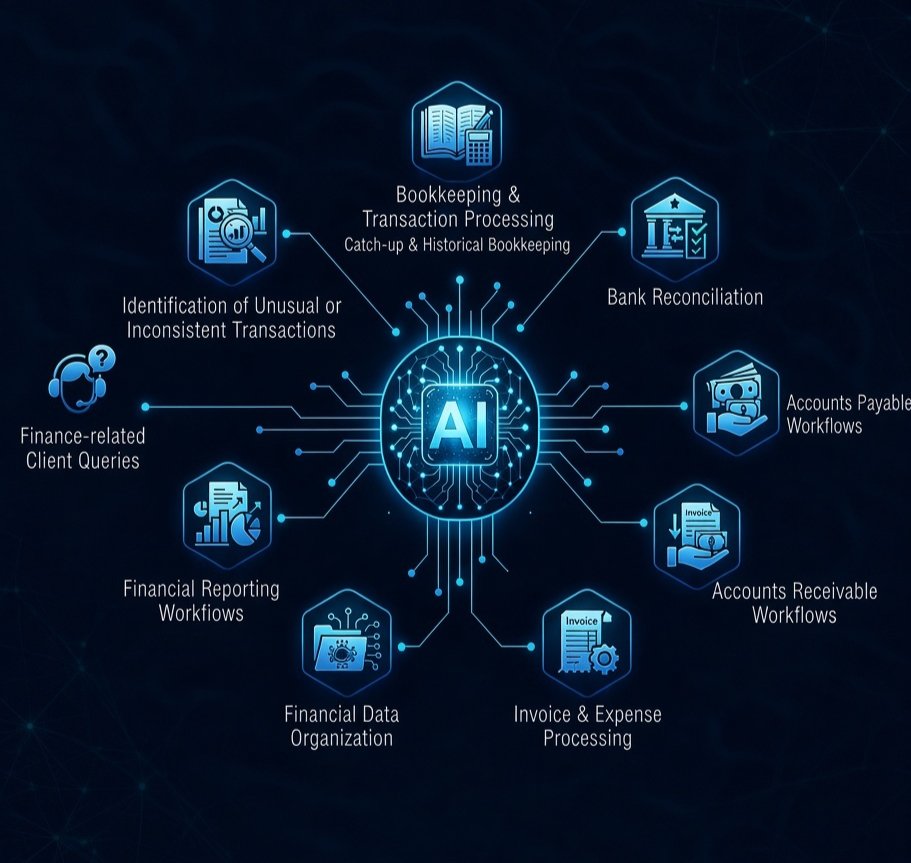
The goal is not automation for its own sake.
The goal is to create a finance operation where repetitive work takes less time, information is easier to access and finance professionals can concentrate on activities that require judgment and business understanding.
Accounting is one of the areas of a business where small inefficiencies can become expensive over time.
A finance team may spend hours downloading statements, matching transactions, checking invoices, following up on receivables or maintaining spreadsheets. When transaction volumes increase, these manual processes become increasingly difficult to maintain.
Accounting automation changes the workflow.
Instead of treating every financial task as a manual activity, businesses can identify repeatable processes and determine where software and AI can safely assist.
For example, a growing company may have transactions coming from multiple bank accounts and payment channels. Reconciling those transactions manually can consume significant staff time.
An automated workflow can help organize the information, identify potential matches and bring exceptions to the attention of the appropriate finance professional.
The important distinction is this:
Automation should reduce repetitive work, not remove financial accountability.
That distinction matters when implementing AI-powered accounting services in a real business environment.
People use social networks to keep up with their friends (or maybe stalk them). If you’re an online business owner and want people to follow or engage with your brand, then you’ll have different priorities than if you just want a place to keep in touch with old friends.
Businesses that use Facebook will want to figure out how to get more likes and how to keep fans interested. The mechanisms that work for this are the same for getting people to ‘like’ your business page on Facebook. Events, contests, and regular posts/updates will get you the attention of new users and keep your existing users following along. Your page on Facebook is a place where you can directly engage with your customers – so use it.
Bookkeeping involves a large amount of recurring data processing.
AI-assisted accounting workflows can help organize transactions, categorize financial information and reduce repetitive manual entry.
For businesses with regular transaction volumes, this can create a more consistent bookkeeping process while allowing accounting professionals to spend more time reviewing exceptions and important financial issues.
The result is not simply faster data entry. It is a finance workflow designed around efficiency.
Bank reconciliation is essential for maintaining reliable financial records.
When businesses operate multiple accounts or process large numbers of transactions, manually comparing accounting records with bank activity can become time-consuming.
Accounting automation can help match transactions, highlight differences and organize exceptions for review.
This makes reconciliation less dependent on repetitive manual comparison.
Human review remains important, particularly when transactions cannot be confidently matched or when unusual activity requires investigation.
Accounts payable can become complicated as a company grows.
Invoices arrive from different vendors, approval requirements vary and payment deadlines need to be monitored.
AI-powered accounting workflows can help businesses organize invoice information, route documents through approval processes and maintain better visibility into outstanding obligations.
This can help finance teams spend less time managing administrative steps and more time monitoring cash flow and vendor relationships.
Getting invoices issued is only one part of the revenue cycle.
Businesses also need visibility into outstanding receivables and customer payment activity.
Automated accounting workflows can help organize receivable information, identify overdue items and support follow-up processes.
For growing businesses, improved visibility into receivables can make financial operations easier to manage and help teams understand where cash is tied up.
Historical bookkeeping can become a major challenge when financial records have fallen behind.
A business may have months of transactions that need to be reviewed, organized and reconciled before reliable financial reporting is possible.
AI-assisted accounting processes can help accelerate the organization and processing of historical financial information.
However, catch-up work still requires appropriate review. Automation can increase processing efficiency, but accounting accuracy depends on the quality of the underlying information and the controls applied to it.
Modern businesses increasingly expect information to be available when they need it.
Instead of relying entirely on long email threads or manually searching through financial records, businesses can use technology-enabled systems to make financial information easier to access.
AI-powered financial assistants can also support routine questions through controlled interfaces.
For example, a business user may want to understand a particular financial transaction, report or accounting status without waiting for a manual response.
The key is ensuring that access to financial information is secure and appropriately controlled.
One of the biggest benefits of accounting automation is scalability.
A manual workflow that works for a small business may become difficult when transaction volumes, employees, vendors and customers increase.
Technology can help businesses build repeatable financial processes that can grow with the organization.
This does not mean every accounting task should be automated.
Instead, businesses can determine which processes are repetitive, measurable and suitable for automation while keeping professional oversight where judgment is required.
The difference is not simply “AI versus humans.”
A better comparison is manual processes versus technology-assisted processes.
Traditional Workflow | AI-Assisted Workflow |
High dependence on manual data entry | More automated data processing |
Repetitive transaction matching | Automated matching assistance |
Manual reconciliation processes | Reconciliation workflows with exception handling |
Spreadsheet-heavy processes | Connected digital workflows |
Manual invoice processing | Automated invoice workflows |
Reactive financial queries | Faster access to financial information |
Difficult to scale repetitive work | More scalable processes |
The best model for many businesses is a combination of technology and people.
AI handles suitable repetitive work.
Accounting professionals handle review, exceptions, judgment and business-specific decisions.
Yes, but the implementation should match the business.
A small company does not necessarily need a complex enterprise finance platform. In many cases, the biggest opportunity comes from automating a few repetitive workflows that consume disproportionate amounts of time.
For example:
Starting with clearly defined processes can make accounting automation easier to implement and measure.
As the company grows, additional workflows can be automated.
No.
AI-powered accounting services can be relevant to startups, small businesses, mid-sized companies and larger organizations.
The difference is usually the complexity of the workflow.
A startup may need help managing bookkeeping and reconciliation efficiently.
A growing company may need stronger accounts payable and receivable processes.
A larger organization may need multi-ledger workflows, more complex integrations, financial automation and controlled access across different teams.
The technology should therefore be designed around the business rather than forcing every company into the same process.
Choosing an accounting automation provider should involve more than looking at whether the provider uses the word “AI.”
Businesses should evaluate the complete operating model.
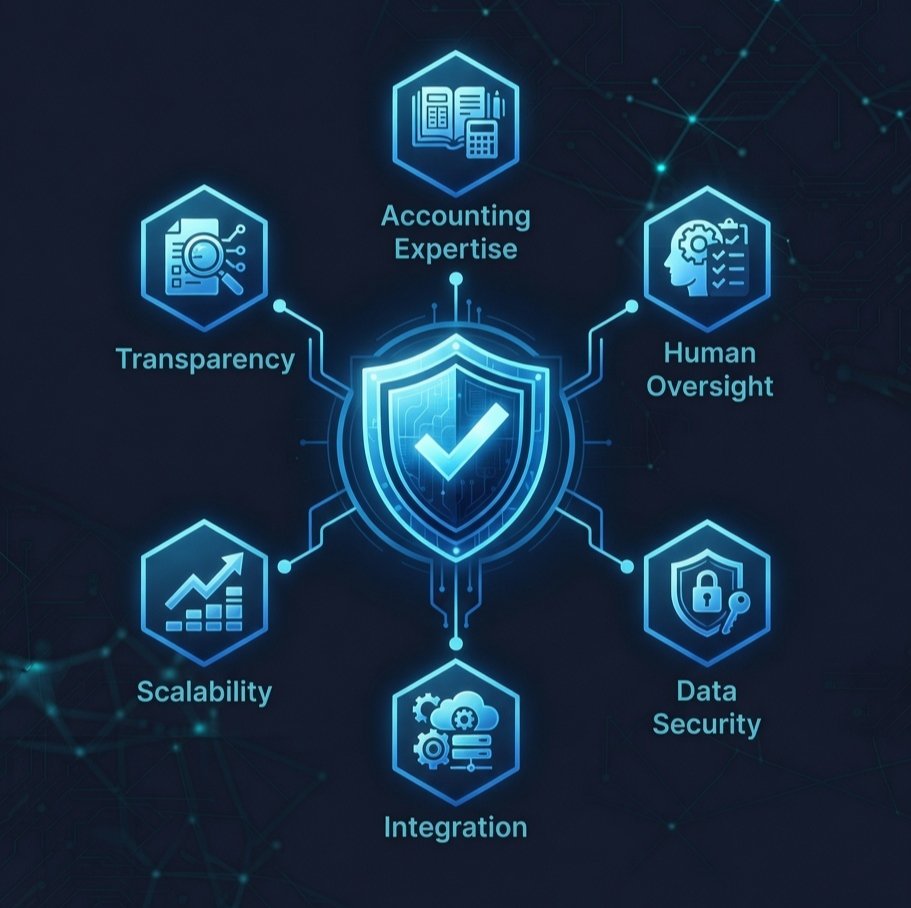
Technology alone does not create reliable financial operations.
The provider should understand accounting workflows and the business context in which the technology is being used.
Businesses should know where automation ends and human review begins.
Clear escalation and exception-handling processes are particularly important for financial operations.
Accounting information can contain highly sensitive business and financial data.
Access controls, secure systems, appropriate permissions and responsible data handling should be part of the implementation.
Accounting automation should work with the systems a business already uses whenever practical.
Replacing an entire technology environment is not always necessary.
A well-designed solution can often improve existing workflows while minimizing operational disruption.
The solution should be capable of supporting the business as transaction volumes and operational requirements increase.
Businesses should be able to understand what is being automated, what is being reviewed and where exceptions are being handled.
Transparency becomes particularly important when AI is involved in financial workflows.
At ATS Software Solution, accounting is one part of a broader technology and business operations model.
Our approach combines AI-powered accounting and financial operations with technology expertise and digital business capabilities.
Our financial operations services include areas such as:
The objective is to help businesses reduce repetitive operational work while creating financial processes that are easier to manage and scale.
Because ATS Software Solution also works across software engineering, generative AI and digital growth, financial automation can be considered as part of a wider technology strategy rather than as an isolated accounting function.
For organizations that need a single service, the engagement can remain focused on that specific requirement.
For businesses looking for broader technology support, financial operations can also work alongside custom software development, AI engineering and digital growth initiatives.
India has become an important destination for global technology and business-process delivery.
For international businesses, an India-based delivery model can provide access to specialized talent while creating opportunities to optimize operational costs.
However, cost alone should not be the deciding factor.
A successful outsourcing relationship also depends on communication, process documentation, quality controls, data security, technical capability and a clear understanding of the client’s business objectives.
ATS Software Solution operates from India and works with a model designed to combine specialized human expertise with technology-enabled workflows.
The focus is on building solutions around the client’s business requirements rather than applying a fixed process to every organization.
There is a common misconception that AI accounting means allowing software to make every financial decision.
That is not how responsible accounting automation should work.
Financial operations often contain situations that require context.
A transaction may look unusual because of a legitimate business event. A vendor invoice may require approval from a specific department. A reconciliation difference may require investigation rather than automatic correction.
AI can help identify, organize and process information.
People remain important for judgment, review and accountability.
This combination is what makes an AI-assisted finance operation practical for real businesses.
AI-powered accounting services use artificial intelligence, automation and accounting workflows to streamline activities such as bookkeeping, reconciliation, accounts payable, accounts receivable and financial information management.
AI can automate many repetitive accounting activities, but it does not eliminate the need for appropriate professional review, financial judgment, controls and accountability.
AI bookkeeping uses automation and artificial intelligence to assist with financial transaction processing, categorization, reconciliation and related bookkeeping activities.
Security depends on the systems, controls and implementation used by the service provider. Businesses should evaluate access controls, data handling practices, permissions, infrastructure and security procedures before selecting a provider.
Yes. Small businesses can use accounting automation for repetitive activities such as bookkeeping, bank reconciliation, invoice processing and receivables management. The technology should be scaled according to the company’s actual needs.
Accounting automation uses software to perform predefined repetitive processes. AI accounting can add capabilities such as pattern recognition, information processing and intelligent assistance. In practice, modern finance operations may use both.
Depending on the technology environment, accounting automation can be integrated with existing systems rather than requiring a complete replacement. Integration requirements should be evaluated before implementation.
An India-based provider can give global companies access to a large technology and finance talent ecosystem and may offer operational cost advantages. Businesses should also evaluate quality, communication, security, expertise and scalability when choosing a provider.
The future of accounting is unlikely to be purely manual or purely automated.
It will increasingly be a combination of both.
AI can process large volumes of information quickly. Automation can reduce repetitive work. Software can connect systems and make information easier to access.
People provide context, judgment, oversight and accountability.
For businesses, the opportunity is to build financial operations around that combination.
AI-powered accounting services can help create a finance function that is more efficient, better organized and easier to scale—but the technology works best when it is implemented around real business processes rather than added simply because AI is popular.
For companies exploring accounting automation, the first step is not necessarily choosing a tool.
It is identifying where the current process consumes the most time, creates the most repetitive work or limits visibility.
From there, the right combination of accounting expertise, automation and AI can be designed around the business.
That is the approach ATS Software Solution brings to modern financial operations: understand the business first, then use technology to make the work smarter.
Use these exact questions in the visible FAQ section and, where appropriate, implement FAQPage/relevant structured data according to Google’s current eligibility and guidelines:

Explore generative AI development services for...





We engineer the digital and financial backbones of global enterprises, delivering unified execution across AI software engineering, automated accounting, and performance growth marketing.
© 2026 — ATS Software Solution All Rights Reserved.


