
ATS Software Solution is a premier global co-sourcing partner driving digital transformation through AI-powered financial operations, enterprise software engineering, and data-validated market growth engines.
Generative AI Development Services
Generative AI has moved beyond simple experiments with chatbots.
Businesses are now exploring how artificial intelligence can work inside their actual operations—searching internal knowledge, assisting employees, communicating with customers, processing documents, generating content, supporting software teams and automating repetitive workflows.
But building a useful AI solution is very different from simply connecting an application to an AI model.
A production-ready AI system needs the right architecture, data, security controls, integrations, user experience and ongoing monitoring.
That is where generative AI development services can make a difference.
At ATS Software Solution, we work across custom software development, generative AI engineering and business automation to help organizations turn practical business requirements into technology solutions.
The starting point is not the AI model.
It is the business problem.
Generative AI development services involve designing, developing and integrating applications that use generative artificial intelligence to create, understand, retrieve or transform information.
Depending on the business requirement, a generative AI solution may use:
The important part is that generative AI development is not simply about selecting a model.
The model is one component of a larger software system.
A successful implementation needs to connect that model to the right business data, workflows and user experience.
Most organizations already have large amounts of information.
It may exist inside:
The challenge is making that information useful.
Employees may spend significant time searching for information, writing repetitive responses, summarizing documents or moving information between systems.
Generative AI can provide another way to interact with that information.
Instead of asking employees to learn where every piece of information is stored, businesses can build intelligent interfaces that allow people to interact with approved company knowledge through natural language.
That is one of the reasons enterprise AI development is becoming more practical.
The answer depends on the business.
There is no single “generative AI solution” that works for every organization.
Some companies may need an internal knowledge assistant.
Others may need customer support automation.
A software company may want an AI development assistant.
A professional-services company may want document analysis.
An enterprise may need an AI layer connected to internal systems.
Common applications include:
Employees often spend time searching through internal documentation.
A custom AI knowledge system can allow employees to ask questions in natural language and retrieve relevant information from approved company sources.
This can be particularly useful when an organization has large amounts of documentation spread across multiple locations.
Businesses receive repetitive customer questions every day.
AI agents can assist with common queries, retrieve relevant information and provide responses based on approved knowledge.
More complex issues can be escalated to human support teams.
The objective is not necessarily to remove customer-service employees.
It is to reduce the amount of repetitive work they have to handle.
Businesses may need AI applications tailored to their own workflows rather than a general-purpose chatbot.
A custom GPT-style application can be designed around a particular business process, knowledge base, role or use case.
Examples include:
Many organizations work with large numbers of documents.
Generative AI can assist with extracting information, summarizing content, answering questions and organizing unstructured information.
This can be useful across areas such as contracts, reports, proposals, policies and business documentation.
Traditional keyword search requires users to know what they are looking for and often requires exact terminology.
AI-powered search can provide a more conversational experience.
A user can describe what they need and receive relevant information based on the available knowledge sources.
Generative AI becomes significantly more useful when it is connected to business workflows.
For example:
A customer submits a request → AI analyzes it → relevant information is retrieved → the request is categorized → the appropriate workflow is triggered → a human reviews it when necessary.
This is where AI development starts moving from a chatbot into business infrastructure.
One of the first questions businesses should ask is whether they actually need custom AI development.
Sometimes the answer is no.
If an existing software product already solves the business requirement, buying or subscribing to that product may be more practical.
Custom development becomes more relevant when a company needs:
The right decision depends on the business requirement.
AI development should solve a real limitation rather than exist simply because a company wants to “use AI.”
A production AI application normally involves much more than sending a prompt to an LLM.
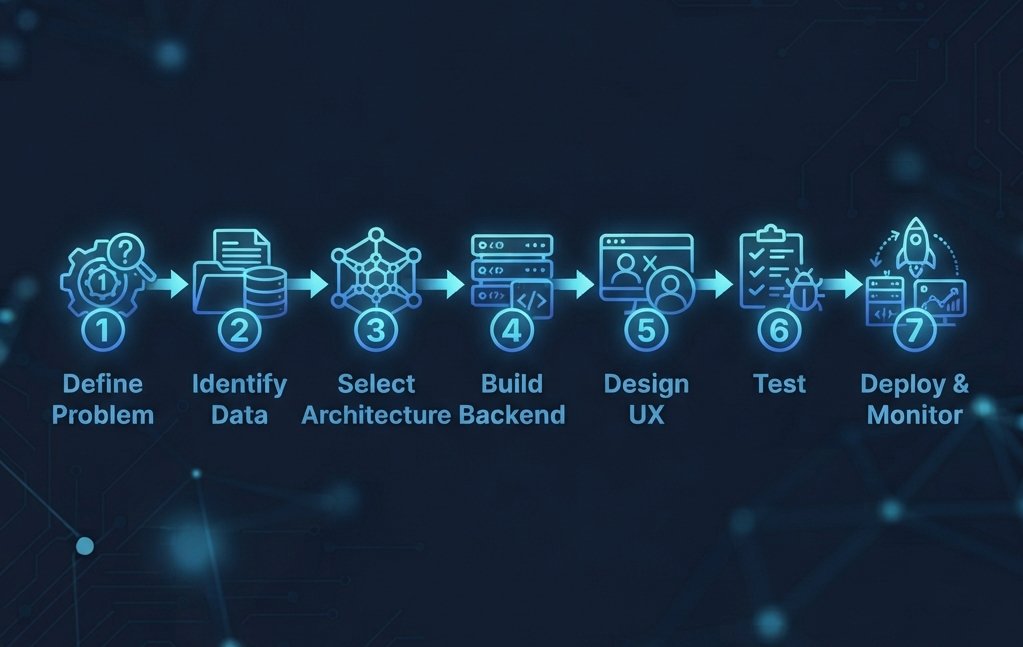
Before selecting a model or framework, the business problem needs to be clearly defined.
What should the system actually accomplish?
Who will use it?
What information does it need?
What should happen when it cannot answer?
These questions establish the foundation of the project.
AI applications are only as useful as the information they can appropriately access.
Relevant sources may include:
The data also needs to be evaluated for quality and relevance.
Different applications require different architectures.
A simple application may use an LLM API.
A knowledge-based application may require RAG.
An automated workflow may require an AI agent.
A highly specialized application may require additional model customization.
There is no reason to use the most complicated architecture if a simpler one solves the problem.
The backend connects the AI capabilities with the rest of the application.
This may involve:
The backend is what turns an AI model into an actual software product.
Users should not have to understand how an LLM works.
They should simply be able to accomplish their task.
Depending on the application, the interface may be:
Good AI development therefore requires both engineering and product thinking.
AI applications need testing beyond conventional software testing.
Developers need to consider:
A system that works perfectly with five test questions is not necessarily ready for production.
AI applications should be monitored after deployment.
Models, data, user behavior and business requirements can change over time.
Monitoring helps identify problems and provides information for future improvements.
Retrieval-augmented generation (RAG) is an architecture commonly used when an AI application needs to answer questions using specific external or private information.
Instead of relying only on what a language model learned during training, a RAG system can retrieve relevant information from an approved knowledge source and use that information when generating a response.
A simplified process looks like this:
User question → retrieve relevant information → provide context to the AI model → generate response
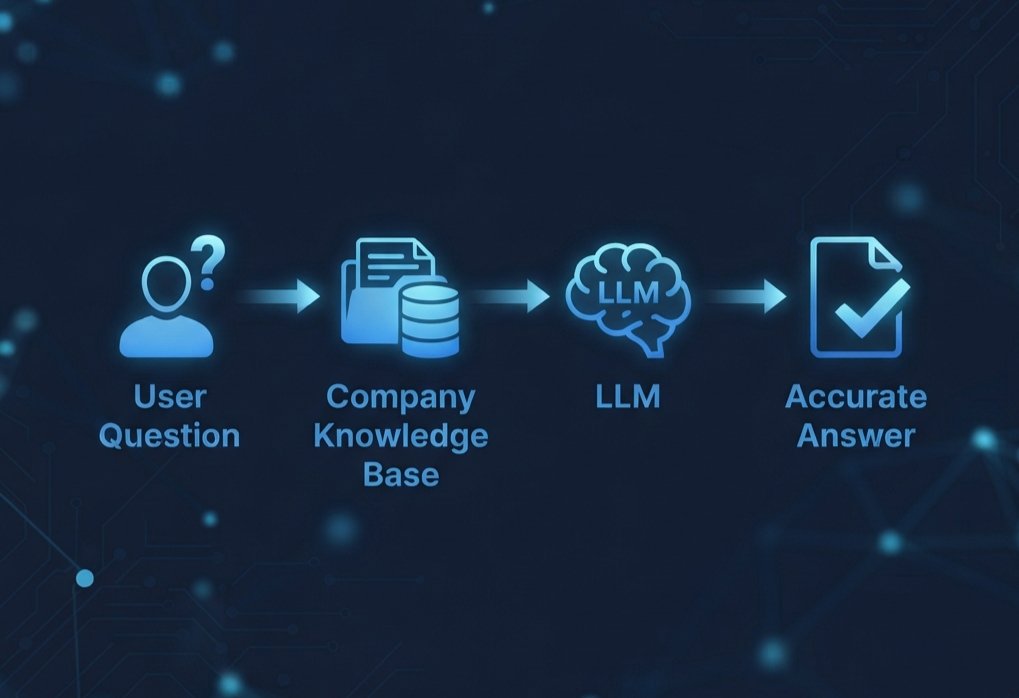
This can be useful for internal company knowledge systems.
For example, an organization may have thousands of internal documents.
Employees could ask:
“What is our current process for handling enterprise customer onboarding?”
The system can retrieve relevant internal information and use it as context for the response.
This makes the AI application more connected to the organization’s actual knowledge.
An AI agent is generally designed to do more than simply respond to a question.
An agent may be able to:
For example, an AI support agent could receive a customer request, retrieve account information through an approved system, identify the relevant policy and prepare an appropriate response.
The exact capabilities depend on how the system is designed.
Agents therefore need strong boundaries.
An AI agent should only have access to the systems and actions it actually needs.
For enterprise applications, model selection is only one part of the project.
Organizations should consider:
For enterprise applications, model selection is only one part of the project.
Organizations should consider:
AI systems need appropriate authentication, authorization and access controls.
What happens when the model provides an incorrect or incomplete response?
When should the system stop and send the task to a person?
How will the business know when the system is performing poorly?
How does the AI application communicate with existing business systems?
These questions often determine whether an AI project becomes a useful business application or remains an experimental chatbot.
Startups often need to move quickly.
They may want to introduce AI into their product without building an enormous technology infrastructure from the beginning.
Custom AI development can help startups build focused solutions around a specific user problem.
For example:
The key is keeping the first version focused.
A startup does not need to build every possible AI capability on day one.
A well-defined AI feature that solves a genuine customer problem can provide a stronger foundation for future development.
Established businesses often have the opposite challenge.
They already have systems, data and workflows.
The question is how to introduce AI without disrupting everything else.
In these environments, integration becomes particularly important.
Generative AI may need to connect with:
This is where custom software engineering and AI engineering need to work together.
AI should become part of the existing technology environment rather than operating as an isolated experiment.
ATS Software Solution provides custom software and enterprise AI engineering as one of its core service areas.
Our capabilities include:
Our approach begins with the client’s business requirement.
We first look at what the organization is trying to achieve, what systems already exist and where AI can create practical value.
From there, the appropriate architecture can be designed.
This may involve a relatively simple AI integration or a larger custom application involving multiple systems.
The technology should follow the business requirement—not the other way around.
India has developed a large technology ecosystem supporting software engineering, artificial intelligence and digital services.
For international companies, working with an India-based technology partner can provide access to engineering talent and potentially create cost efficiencies.
But location should not be the only consideration.
Businesses evaluating generative AI development services in India should also examine:
A successful AI development relationship requires more than developers who know how to call an AI API.
It requires people who understand how to turn a business problem into a reliable software system.
There is no single price for a generative AI development project.
The cost can vary significantly depending on:
A simple AI assistant and an enterprise AI platform are fundamentally different projects.
Businesses should therefore define the required functionality before attempting to estimate development cost.
A useful development proposal should clearly explain:
Starting with “we need AI” is rarely enough.
Start with the problem.
Starting with “we need AI” is rarely enough.
Start with the problem.
AI systems should have only the permissions necessary for their intended function.
Some tasks should always have a path to human review.
A successful demonstration is not the same as a reliable enterprise application.
Production systems require security, monitoring, testing, error handling and operational processes.
Generative AI development services involve designing and building software applications that use technologies such as large language models, AI agents, RAG and conversational AI to solve specific business problems.
AI development is a broad term covering many types of artificial intelligence systems. Generative AI development specifically focuses on systems capable of generating or transforming content such as text, code, images or other information.
Yes. Depending on the architecture, AI applications can be connected to approved company data through APIs, databases, knowledge bases, RAG systems and other integration methods.
AI agents can be designed to perform multi-step tasks, retrieve information, interact with approved tools and support automated workflows.
Yes. Small businesses can use generative AI for focused applications such as customer support, internal knowledge, content workflows, document processing and productivity.
The timeline depends on the complexity of the application, integrations, data requirements, security requirements and desired functionality. A focused AI feature generally requires a different development process from an enterprise AI platform.
Start by identifying a specific business problem, defining the users and desired outcome, assessing available data and determining whether an existing AI product or custom development is the appropriate approach.
Generative AI is evolving quickly.
But businesses do not necessarily need the latest model or the most complicated AI architecture.
They need technology that solves real problems.
For one organization, that might mean an internal knowledge assistant.
For another, it could be an AI customer-support agent.
Another company may need document intelligence, an AI-powered SaaS feature or a custom enterprise knowledge system.
The underlying principle is the same:
Start with the business problem. Design the technology around it.
That is the foundation of effective generative AI development services.
At ATS Software Solution, we combine AI engineering, custom software development and business-focused technology delivery to help organizations explore and implement practical AI solutions.
From conversational AI and custom GPT applications to internal knowledge systems and integrated enterprise software, the goal is not simply to add AI to a business.
The goal is to build software that makes the business work better.

Explore generative AI development services for...




We engineer the digital and financial backbones of global enterprises, delivering unified execution across AI software engineering, automated accounting, and performance growth marketing.
© 2026 — ATS Software Solution All Rights Reserved.


